Curiosity ~ Lucidity ~ Humanity

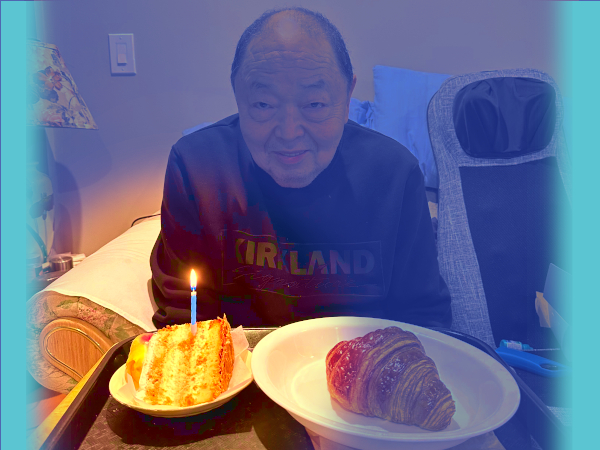
I sat in the driver’s seat of the car, silently fuming as I watched my dad struggle to put on his seatbelt. With one mobile arm, he feebly reached for the seatbelt across his right shoulder to buckle the latch plate. His right arm sat motionless against the side of his body, elbow limp at a weak 90-degree angle. I felt equally frustrated that a simple task was so difficult for him—causing the car’s incessant alarm to beep—and that I couldn’t summon the compassion we both needed in that moment. The indications of my dad’s aging settled further in to define our shared reality and became harder to ignore.
My typical Sunday morning routine started like any other weekend until my dad called out my name. His calm yet serious voice quickened my heart rate. I knew shouting back, “What?” would be futile—the distance from my bedroom, down the stairs, and to the living room would evaporate my words. I slipped on my coat, acting as if I were ready to head out after a quick discussion.
“I can’t move my arm. I need to go to the emergency room. The juicer needs to be fixed,” my dad said when he saw me.
His unbrushed hair and pain-stricken face filled me with equal parts melancholy, fear, and exasperation. He handed me the feeder chute and juice chamber parts, standing by the juicer as though waiting for me to assemble them. I fixated on trying to attach the pieces together, thinking, I can’t help his arm, but I can fix the juicer. The more I tried to jam the parts together, the more irritated I became. Why were we focusing on the damn juicer when we should be heading to the hospital?
“Is urgent care open today?” he asked.
Holding the juicer parts in hand, my voice became urgent, my annoyance evident. “Yes. Do you want to go to urgent care or the emergency room?”
My frustration hardened my heart. What I really wanted to ask was, What happened? Where does it hurt? What can I do now to lessen the pain?
Click. The juicer parts locked into place.
“Let’s go to urgent care,” my dad decided.
My body switched to autopilot: Start the car. Signal to turn. Inhale. Stop for the pedestrian. Exhale. Even in pain, my dad’s authentic self shone through as he noticed the thick road congestion stretching ahead for at least two miles. A first-generation immigrant from China who has called San Francisco home for over four decades, he knows every road speed bump, four-way stop, traffic light, and side street shortcut in the city.
“Let’s turn right at the intersection up ahead,” he guided me, rerouting as our human GPS.
I’m never ready for the stark, sterile environment of a hospital. The cushioned armrest seats, the posters of smiling people advertising health services, and the pastel-colored accent signs fail to distract me from the reality of where we are. On a Sunday, it’s eerily quiet and deserted.
Walking up to the medical receptionist, I stepped into a role ingrained in my identity—translator for my non-English speaking parent—checking him in and discussing the next available appointment. It wasn’t until we sat in the waiting room, staring at power outlets and the speckled floor, that I noticed my dad’s sweater was on backward.
During the agonizing wait, I felt the worst emotion of all: pity. Where is the strong, bold dad I once knew? That pity led to anger—I had to cancel my plans. Anger morphed into shame as I thought about myself during such a vulnerable moment for my dad.
After hearing that the estimated time before the next appointment would be an hour, my dad said, “You have places to be. You can go if you’d like.”
For a fleeting moment, relief and the possibility of escape crossed my mind. Before he could change his mind, I played out the scenario in my head—meeting my friends to leave him alone, waiting. The thought was too unbearable, too shameful to entertain. I decided to stay because I knew that if I left, my thoughts would haunt me.
Hospitals are a series of hopeful disappointments. We were called from the waiting room by a nurse to check his vitals, then sent to a private room. The nurse returned to ask intake questions and left again. Boredom drove me to open every single cabinet, despite their clear medical supply labels–Specimen Containers, Tongue Depressors, Band-Aids, Swabs, Gauze Pads. Meanwhile, I noticed more about my dad—the unkempt bed hair, the deep lines around his cheeks, the slump of his shoulders. With every shadow passing under the door and every murmur of voices, I stared longingly at the closed door, hoping the doctor would finally arrive.
A knock broke the silence. Dr. Jace entered with a warm smile. My dad removed his sweater, and Dr. Jace noticed the swelling in his arm and his winces of pain during the examination.
“I’d like you to get an X-ray upstairs,” Dr. Jace said. “Come back after you’re done.”
Before we left, Dr. Jace took photos of my dad’s elbow.
“Don’t worry, you won’t be an elbow model today,” he joked.
The language barrier prevented my dad from understanding, but I smiled at the attempt to lighten the moment.
I waited outside while the radiologist X-rayed my dad’s elbow, taking a moment of solitude to let out a long sigh. Tears fell as the weight of caring for an aging parent sank in. I thought about my dreamt-up hopes, unmet aspirations, and unknown prospects. How do my wishes and my duties align?
The scan results revealed severe arthritis, with his bones grinding against each other. We left the hospital feeling defeated, my dad hobbling slowly behind me, armed with nothing more than a prescription for topical cream—a small solace for the pain he rated eight out of ten. Before we left the exam room, the nurse practitioner fitted an adjustable arm sling for comfort.
We stumbled when it came time for my dad to put his sweater back on. His swollen, unyielding arm couldn’t fit through the raised armhole of the sweater. The audible stretch of the cotton at its seams startled me, forcing me to stop. Beginning again gently, I guided his right arm, then left arm, through the sleeves first, then pulled the sweater over his head, moving with a tenderness that felt at once foreign in its novelty and familiar in its roots.
I wavered at the simplicity and mundaneness of this act. How many times had he dressed me as a child—strong hands lifting my arms and threading them through sleeves, his steady voice coaxing me to close my eyes as the fabric passed over my head? How many times had I squirmed, resisting his efforts, my small body wriggling against his calm persistence? How many times has his presence been an anchor to my instability? And now, how many more times would I dress him in this reversed world—different bodies, different roles, but the same quiet intimacy?
Looking at him now, sweater slightly off-center because of the sling, I wondered how he could look even more delicate and frail than when we had arrived. Back at the car, I opened his door and buckled him in. The doting, obedient daughter role came naturally now that we had some answers. In the ephemeral moments between vexation and compassion, I reflected on the shifting dynamics of our relationship—what it means to truly care for someone I always relied on.
Filial piety evolves into a tangled tension of unconditional love, obligation, and resentment when caring for an elderly parent. These emotions coexist with a growing compassion, patience, and self-awareness.
“I’m so glad you were available today,” my dad said softly as we neared home. His words form a lodge in my throat, unsteadying my nerves. My heart swells and shatters, grateful that I was there while questioning the inevitabilities of my young adult life.
When we walked into the house, the juicer stood exactly as we had left it: whole and unbothered. My desire to fix and be in control revealed a greater truth–simply showing up and being present is enough.
Bio-Fragment: Waresa Hu is a writer and educator based in San Francisco. Her work explores identity, family, and belonging. She has an enduring fondness for estate sales, which she considers equal parts bargain hunting and polite snooping.